


Pines Peak: Merge Travel Games
VIZOR APPS LTD.
I went into Pines Peak: Merge Travel Games expecting a light puzzle game, and that is exactly where it fits best: a relaxed merge experience built around collecting, combining, and gradually opening up a cheerful travel-themed setting. It is free to play, aimed at Everyone, and developed by VIZOR APPS LTD. The basic idea is easy to understand, but the real question is whether the steady rhythm of merging feels satisfying enough to keep you coming back.
After spending time with it, I think the answer depends on what you want from a mobile puzzle game. If you enjoy organizing a crowded board, making small upgrades, and checking in for short sessions, this has a pleasant loop. If you prefer compact logic puzzles with a clear finish, fast competitive play, or a game that gives you everything immediately, its slower progression may feel restrictive.
How the everyday merge loop works
The most natural way to play is in short bursts. I open the game, look over the available pieces, identify obvious pairs, and then decide whether to complete a simple request or tidy the board first. That last step matters more than it seems. Merging without a plan can leave useful items trapped behind clutter, while a few seconds of organization often creates room for several better combinations.
The appeal comes from turning several modest objects into something more valuable. Each successful combination gives the board a sense of movement, even when the change is small. I like that the game does not demand complicated controls or a long tutorial before becoming understandable. The interaction is familiar enough for casual players, yet the limited space encourages decisions instead of endless tapping.
A realistic use case is a commute, a coffee break, or the few minutes before bed. I would not choose it for a focused gaming session where I want a dramatic challenge, but it works well when I want something gentle that still gives me a reason to think. A short visit can involve clearing a few pieces and stopping, while a longer visit lets me work toward a larger board objective.
Related News






The travel and town presentation gives the merging a little more personality than a plain grid of identical objects. The setting makes progress feel connected to a place rather than being only a sequence of combinations. That atmosphere is useful when the puzzle itself is intentionally calm. I found myself returning partly because I wanted to see the surroundings develop, not just because I wanted another merge.
A practical starting routine
My preferred opening routine is simple. I first scan the whole board instead of immediately touching the most obvious pair. I look for groups that can be combined in more than one way, check which spaces are open, and then handle the move that creates the most room. This avoids the common mistake of making a convenient merge that blocks a more useful chain.
When several tasks compete for attention, I focus on the one that uses items already visible. Chasing a distant upgrade can consume space and time, while completing a nearby objective often restores flexibility. I also avoid treating every empty space as a reason to produce more objects. Empty room is valuable in a merge game because it gives you options when a new item appears.
Gallery
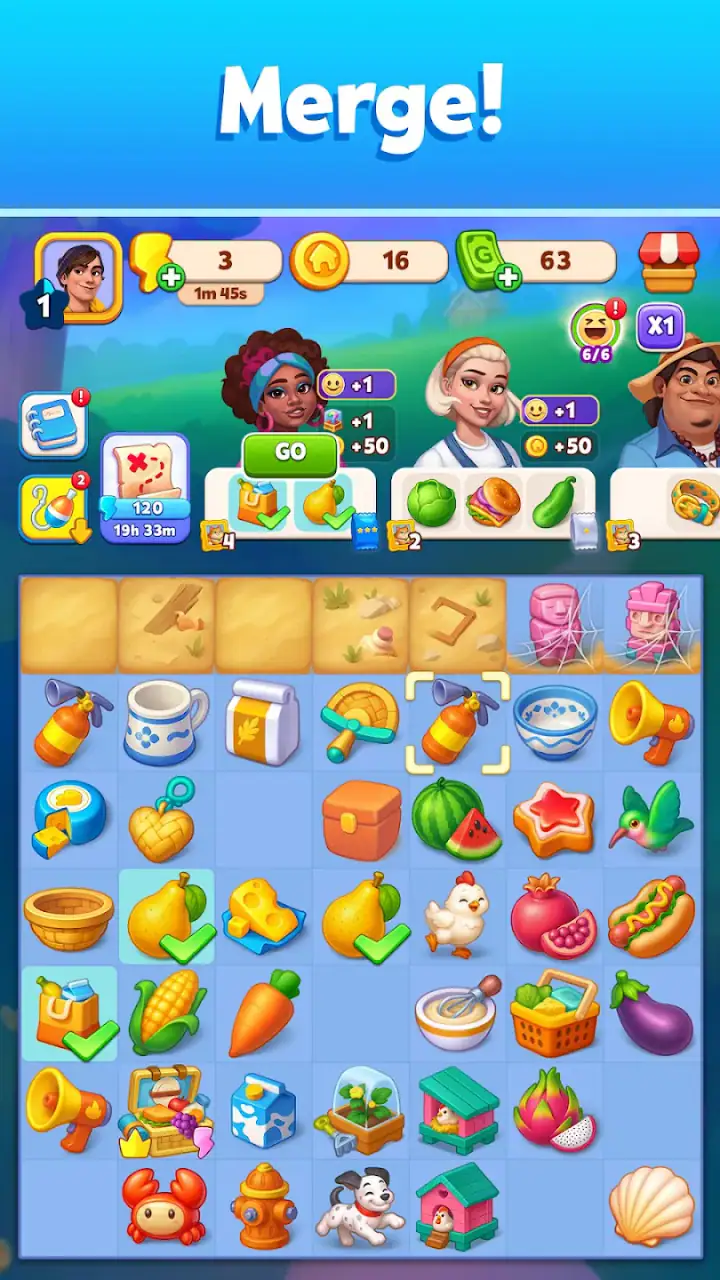
That habit is especially helpful for players who are used to match-three games. In a match-three board, the best move is often the one that creates an immediate reaction. Here, the best move may be the one that looks less exciting but preserves room for the next sequence. The game rewards patience more than reflexes, and that changes how I evaluate a good turn.
Settings and comfort choices worth checking
Before settling into longer sessions, I recommend checking the available in-game settings on your device and inside the game. I pay attention to sound, music, notifications, and any options that affect how often the game interrupts me. These choices are not part of the puzzle strategy itself, but they strongly influence whether the game feels calming or demanding during everyday use.
I usually lower or disable audio when playing in public, then leave enough sound on at home to make the interactions feel more satisfying. Notifications deserve similar attention. A reminder can be useful if you enjoy returning to a game at regular intervals, but it can also turn a peaceful puzzle into another source of pressure. I prefer deciding when to play rather than feeling chased by the game.
It is also worth checking the device requirements before installing. The game supports Android versions from 6.0 onward, which makes it accessible to many older Android devices. That does not guarantee identical performance on every phone, so I would still pay attention to how smoothly the board responds on your particular device, especially if you keep many apps open or have limited storage available.
For families, the Everyone age rating makes the game easier to consider as a general-audience title. Even so, I would explain the optional purchase model before handing it to a child. The game is free to start, but its in-app purchases range from $0.99 to $99.99 per item. That is a broad range, so device-level purchase controls are a sensible precaution for shared phones and tablets.
Small habits that make the board easier to manage
The most useful habit I developed was separating “progress pieces” from “storage pieces.” Some objects are worth keeping because they are close to a meaningful combination or tied to an active request. Others are simply occupying space until a better opportunity appears. I try not to let temporary items spread across the board. Grouping similar pieces makes future decisions faster and reduces accidental clutter.
I also avoid completing every possible merge immediately. Sometimes a lower-level item is more useful as part of a future pair than as a finished object sitting alone. This is a subtle trade-off: merging can look like progress, but progress that removes flexibility may slow the next few moves. When the board is crowded, I value open space and predictable groups more than the biggest available combination.
Another practical technique is to pause after a major chain. Instead of continuing automatically, I reassess the board. New opportunities may have appeared, and the best next action may be different from the one I had planned. This pause is easy to skip because the game encourages a smooth rhythm, but it prevents me from spending useful pieces simply because I am already in motion.
For longer sessions, I use a repeatable cycle: inspect, clear the most restrictive area, complete the nearest sensible objective, then reorganize. Repeating that cycle keeps the game from becoming a random sequence of taps. It also makes it easier to stop at a natural point, because I can finish after the board has been reset into a manageable state rather than leaving it in confusion.
Where it differs from familiar puzzle alternatives
Compared with match-three games, this is less about rapid pattern recognition and more about inventory management. There is usually less pressure to react instantly, but more responsibility for deciding what to keep and where to place it. Players who enjoy planning several moves ahead may prefer this structure, while people who want immediate visual explosions may find it too measured.
Compared with traditional logic puzzles, the game is more forgiving and more decorative. A logic puzzle usually asks you to solve a defined problem and gives you a clear conclusion. Here, progress is ongoing, and the satisfaction comes from gradual improvement. That makes it easier to play casually, although it can also make the experience feel repetitive if you need a strong sense of completion.
It also sits apart from pure decoration or town-building games because the merge board is the main source of interaction. The setting gives context to progress, but the central activity remains combining items. I would choose this over a purely decorative game if I wanted more decisions, but I would choose a dedicated strategy game if I wanted deeper systems, faster consequences, or more demanding planning.
The game’s current version is 12607.1.2, and its store presence shows a 4.7 average from around 6.7 thousand ratings, with over 100 thousand installs. Those figures suggest that the approachable merge format is connecting with a real audience, though they do not change the basic fit question: this is best for players who enjoy gradual, repeatable progress.
What experienced players should watch closely
The main advanced limit is board pressure. A player who treats every object as equally important will eventually run out of comfortable space and start making defensive moves. The solution is not simply to merge faster. It is to preserve a clear working area, keep related pieces together, and avoid building long chains without knowing where the resulting items will go.
There is also a tension between immediate requests and long-term organization. Completing a request can feel rewarding, but it may consume an item that would have helped create a more efficient chain. I usually favor the request when it clears space or unlocks a useful next step. If it only removes one object while leaving the board crowded, I prefer to prepare first.
Energy, waiting, or other progression limits can shape the pace of a free-to-play merge game, so players should expect that the most efficient strategy is not always the fastest-looking one. I do not spend simply to avoid every pause. Instead, I use waiting periods as a reason to stop, check another task, and return later with a clearer plan. That keeps the game in its strongest role as a casual companion rather than turning it into a demand on my attention.
The purchase structure is another boundary. Someone who wants a completely uninterrupted experience may become frustrated if progress encourages optional spending. I would recommend trying the free portion with a firm personal rule before buying anything. If the game remains enjoyable when played at its natural pace, purchases are easier to judge as optional conveniences rather than necessities.
Players should also know that the calm presentation does not mean there is no decision-making. The difficulty is mostly self-created through poor organization. That is both a strength and a weakness. I like having room to improve through better habits, but a player looking for clearly staged puzzles may find the challenge too indirect.
Who will enjoy it, and who should skip it
I would recommend this to people who like cozy puzzle games, collecting systems, and progress that accumulates over repeated visits. It is a good match for someone who enjoys arranging a board, spotting combinations, and making a little progress during spare moments. It may also suit families looking for an approachable game, provided an adult manages the purchase settings on a shared device.
I would be more cautious recommending it to players who dislike free-to-play pacing, optional purchases, or tasks that can feel repetitive. If you want a game with a definite ending in each session, a traditional puzzle app may be a better choice. If you want competition, timed rounds, or fast reactions, a match-three title will probably provide a stronger fit.
I also would not pick it for a phone with very little free space or for someone who expects every session to deliver a major story development. Its pleasure is incremental. The game asks you to appreciate a well-managed board, a completed objective, and a gradually more inviting setting. Those rewards are modest, but they can be satisfying when that is the mood you are in.
My final take after settling into its rhythm
The strongest reason to try Pines Peak is its combination of gentle presentation and surprisingly meaningful board organization. It is easy to begin, yet experienced play benefits from habits such as scanning before moving, protecting empty space, grouping related pieces, and stopping to reassess after a chain. Those habits give the game more depth than its simple controls suggest without turning it into a stressful puzzle.
At the same time, I would not pretend it is ideal for everyone. The free-to-play structure, optional purchases, gradual pace, and possibility of board clutter are real considerations. I enjoyed it most when I treated it as a small daily ritual rather than a game I needed to conquer quickly. That approach made the waiting and repetition feel natural instead of frustrating.
With an Everyone rating, a free starting point, and support for Android 6.0 and later, it is easy to test whether the loop suits you. My advice is to play slowly at first, learn how much space your board needs, and resist spending until you know whether the normal rhythm is enjoyable. If you like cozy merge puzzles with a travel-flavored setting, this is a friendly choice. If you need constant novelty or a crisp puzzle finish, I would look elsewhere.
Overall, I see it as a pleasant, low-pressure puzzle game for organized casual players. Its best moments come from making a careful decision several moves before the reward becomes obvious. That is not a flashy kind of mastery, but it is exactly what kept me interested: the feeling that a tidier board and a little patience can turn a slow session into a satisfying one.
FAQs for Pines Peak: Merge Travel Games
What is Pines Peak: Merge Travel Games about?
Pines Peak: Merge Travel Games is a casual merge-and-adventure game centered on exploring scenic locations, completing tasks, and progressing through a story. You combine matching items to create upgraded objects, then use those items to restore areas, solve objectives, and unlock new parts of the map. Its relaxed pace makes it suitable for short play sessions, although progress is generally tied to energy, resources, and timed activities.
How does the merging gameplay work in Pines Peak?
The main gameplay loop involves dragging identical objects together to merge them into a more advanced item. Higher-level objects are used to fulfill orders, complete renovation goals, or advance quests. The board can become crowded, so planning is important: it is usually better to keep useful chains organized instead of merging everything immediately. Special rewards, event items, and resource generators may also affect how efficiently you progress.
Can Pines Peak: Merge Travel Games be played offline?
Some basic parts of the game may be available without a constant internet connection, but an online connection can be required for loading advertisements, synchronizing progress, receiving updates, accessing limited-time events, or using certain social and promotional features. Offline availability may also vary between Android and iOS versions. If you intend to play while traveling, it is best to open the game online first and confirm which features remain accessible.
Is Pines Peak: Merge Travel Games free to download and play?
Pines Peak: Merge Travel Games can generally be downloaded for free, but it may include optional in-app purchases. These purchases can provide premium currency, energy, boosters, extra storage, or faster progress. You can usually play without spending money, although waiting periods and limited resources may make progression slower. Before downloading, parents and users should review the store listing and device purchase settings to avoid accidental transactions.
Is Pines Peak suitable for children and casual players?
The simple controls and colorful merge mechanics make Pines Peak approachable for casual players, including people who prefer relaxed puzzle and decoration games rather than fast action. However, the game may contain advertisements, optional purchases, timers, and reward systems that encourage repeated play. Parents should check the age rating, privacy information, and available parental controls, especially if children will use a device with payment details saved.
Pros
- Relaxing merge gameplay suited to short or casual sessions.
- Travel-themed locations give progression a pleasant sense of discovery.
- Simple controls make it accessible for players of all ages.
- Puzzle mechanics are easy to learn without lengthy tutorials.
- Frequent objectives help provide direction while exploring levels.
Cons
- Energy or waiting systems may interrupt longer play sessions.
- Some upgrades can require repeated merging and resource grinding.
- Progress may feel slow without optional purchases or patience.
- Visual effects and animations can become repetitive over time.
- An internet connection may be needed for certain features or progress.


